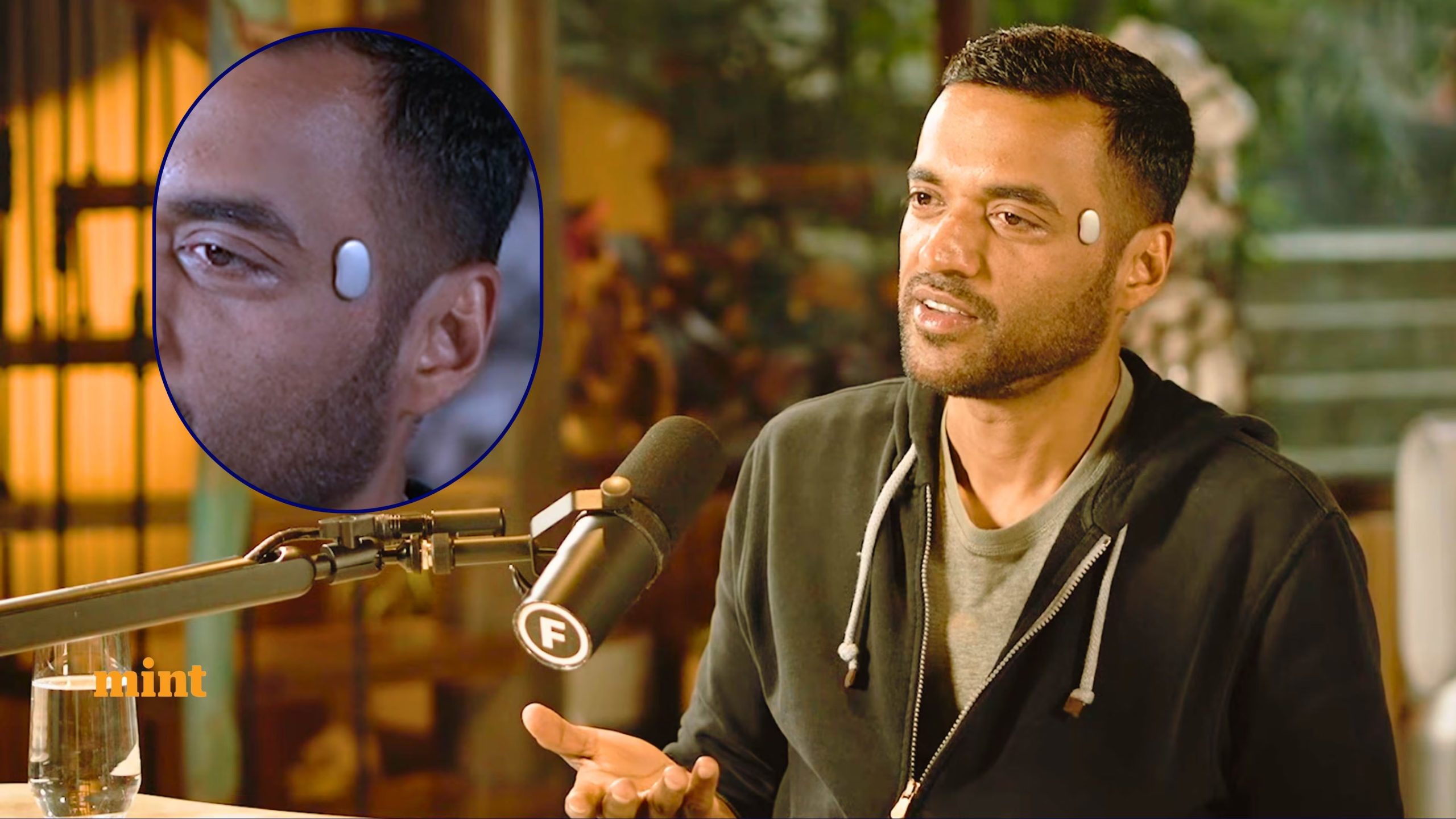
When Deepinder Goyal, the founder of Zomato and Eternal, sat down for a candid conversation on Raj Shamani’s Figuring Out podcast, viewers were instantly distracted. It wasn’t just the business insights that caught people’s attention, but a sleek, metallic, coin-sized gadget attached to his temple.
Speculation ran wild—was it a futuristic hearing aid? A specialised SSD? The truth is far more ambitious. The device, aptly named “Temple,” is a cutting-edge wearable designed to monitor Cerebral Blood Flow (CBF) in real-time. Developed under Goyal’s research venture, Eternal and Continuous Research, this device represents a bold leap from food delivery to deep-tech neurological health.
What is the “Temple” Device?
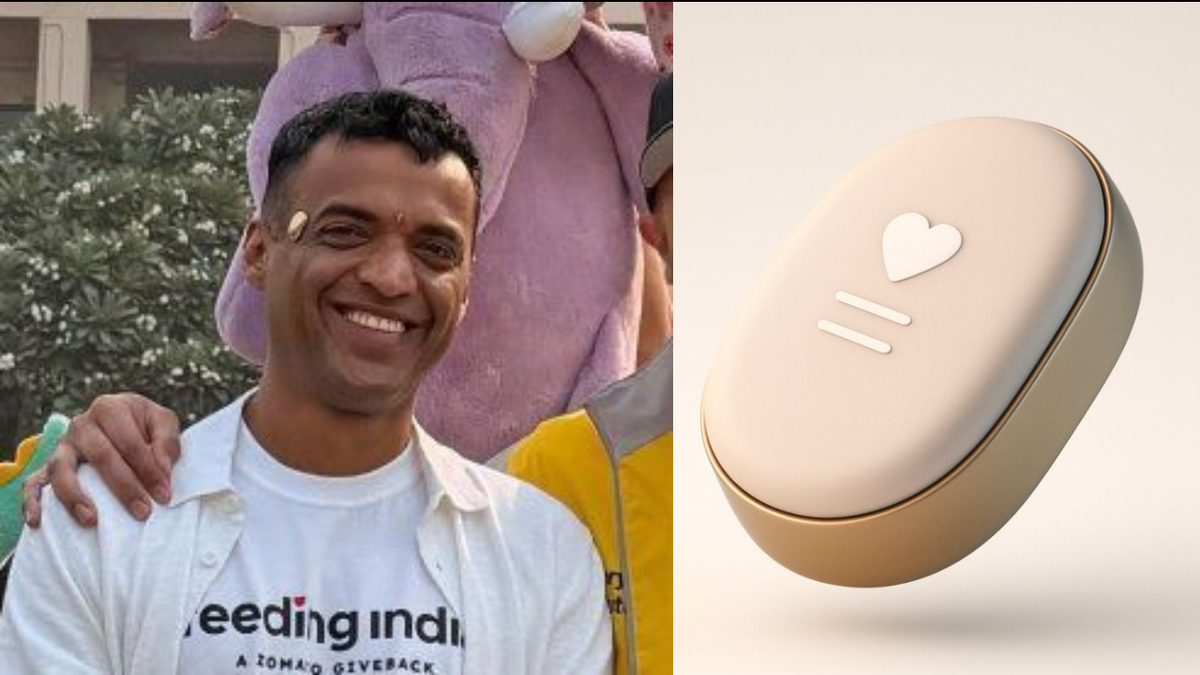
The Temple device is an experimental, non-invasive wearable sensor. Unlike traditional fitness trackers that measure heart rate or steps, Temple focuses exclusively on the brain. Positioned on the temporal bone—where the skull is thinnest and major arteries are accessible—the device uses advanced sensors to track how much blood is circulating through your brain at any given moment.
While full technical specifications remain proprietary, similar research-grade wearables often utilise Functional Near-Infrared Spectroscopy (fNIRS) or Ultrasound Patch technology. These methods send signals through the skull to measure the velocity and volume of blood moving through cerebral vessels.
The Science: Monitoring Cerebral Blood Flow (CBF)
Cerebral blood flow is the lifeblood of cognition. Your brain, though only representing about 2% of your body weight, consumes roughly 20% of your body’s oxygen and glucose.
Why monitoring matters:
- Cognitive Optimisation: Real-time data can show when your brain is experiencing “mental fatigue.” Just as an athlete monitors muscle strain, a professional can use Temple to identify when their brain needs a break to maintain peak focus.
- The Gravity Ageing Hypothesis: Deepinder Goyal has been vocal about his theory that constant upright posture—driven by gravity—subtly starves the brain of optimal blood flow over decades. He suggests this “perfusion deficit” could be a hidden driver of neurological ageing.
- Early Detection: Fluctuations in brain blood flow are early biomarkers for conditions like strokes, dementia, and chronic stress.
Key Uses and Potential Benefits
Though currently in an experimental “research-only” phase, the implications of a consumer-grade brain monitor are vast.
-
Fighting “Gravity Ageing”
Goyal’s team is exploring how inversion therapy (hanging upside down) or specific postures can increase blood flow to the brain’s ancient centres, like the hypothalamus and brainstem. The Temple device acts as the “odometer,” measuring whether these interventions actually work.
-
Stress and Emotional Regulation
By tracking how blood flow shifts during high-pressure situations, users can gain “biofeedback.” If the device detects a drop in flow associated with a stress response, it could prompt the user to perform breathing exercises to restore balance.
-
Longevity and Neuro-Protection
In the longevity community, “perfusion is life.” Maintaining high-quality blood flow as we age ensures that neurons are properly nourished and metabolic waste is cleared. Continuous monitoring allows for a proactive approach to brain health rather than waiting for symptoms of decline to appear.
A Revolutionary Tool or a “Billionaire’s Toy”?
The debut of Temple hasn’t been without controversy. Some medical experts have cautioned that using the temporal artery as a surrogate for overall brain health is complex and prone to “noise” or inaccurate readings. They argue that while the tech is fascinating, it requires years of clinical validation before it can be considered a diagnostic tool.
However, Goyal’s approach is not necessarily to replace doctors, but to open-source the data. By investing nearly $25 million into this research, he aims to provide a tool for “curious humans” to track their own biomarkers and push the boundaries of what we know about human lifespan.
The Future of Wearable Brain-Tech
The “Temple” device is a sign of where the wearable market is headed. We are moving past “counting steps” and into the era of “counting neurons.” Whether or not the Gravity Ageing Hypothesis holds up under scientific scrutiny, the ability to see inside our own heads in real-time is a powerful shift in personal health.
As the device moves toward a potential public rollout, it signals a future where “brain flow” is a metric as common as “heart rate.” For high-performers, students, and anyone interested in longevity, the Temple device might just be the most important accessory of the decade.