
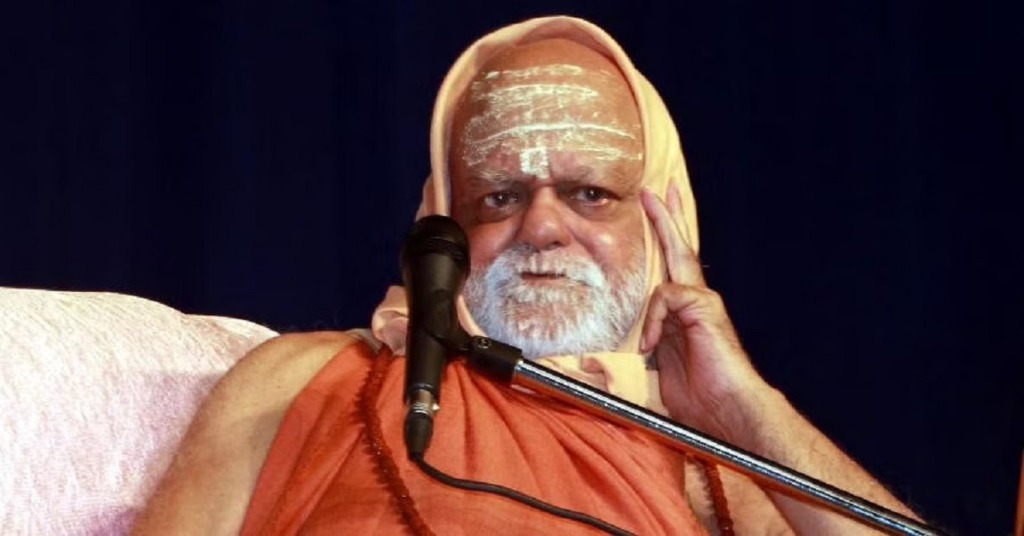
Shankaracharya Swami Nischalananda Saraswati is one of the most prominent contemporary spiritual leaders of India and the present Shankaracharya of Govardhan Peeth, Puri, one of the four cardinal monastic seats (Chatur Amnaya Peethas) established by Adi Shankaracharya in the 8th century. Known for his deep scholarship in Advaita Vedanta, uncompromising adherence to Vedic traditions, and outspoken views on social, political, and religious matters, Swami Nischalananda Saraswati has played a significant role in shaping modern Hindu discourse.
His teachings emphasize the revival of Sanatana Dharma, strict observance of Vedic principles, and the preservation of India’s spiritual and cultural heritage. Over the decades, he has emerged as both a revered spiritual authority and a controversial public intellectual.
Early Life and Background
Swami Nischalananda Saraswati was born on June 30, 1943, in Haripur village of the Nalanda district, Bihar, India. His birth name was Nilambar Jha, and he was born into a traditional Brahmin family deeply rooted in Vedic culture.
From an early age, Nilambar Jha showed exceptional intellectual ability, spiritual inclination, and a strong interest in scriptures. He excelled in studies related to Sanskrit, logic, philosophy, and Vedic literature, which later became the foundation of his spiritual journey.
Despite his academic brilliance, he developed a strong sense of detachment from worldly pursuits, eventually choosing the path of renunciation.
Spiritual Initiation and Monastic Life
Nilambar Jha became a disciple of Swami Karapatri Ji Maharaj, one of the most influential saints of 20th-century India and the former Shankaracharya of Govardhan Peeth. Under his guidance, Nilambar Jha received rigorous training in:
- Advaita Vedanta
- Vedas and Upanishads
- Dharmashastras
- Indian philosophy (Darshanas)
- Sanskrit grammar and hermeneutics
After embracing Sannyasa (renunciation), he was given the monastic name Swami Nischalananda Saraswati. His austere lifestyle, discipline, and mastery over scriptures distinguished him among spiritual scholars.
Appointment as Shankaracharya of Govardhan Peeth
In 1992, following the tradition established by Adi Shankaracharya, Swami Nischalananda Saraswati was appointed as the Shankaracharya of Govardhan Peeth, Puri (Odisha).
The Govardhan Peeth represents the Rig Veda and focuses on the spiritual upliftment of humanity through knowledge (Jnana). As Shankaracharya, Swami Nischalananda Saraswati assumed responsibility for:
- Preserving Advaita Vedanta
- Guiding Hindu religious practices
- Providing spiritual leadership
- Addressing social and moral challenges
His appointment was recognized by several prominent saints and religious scholars, although, like many religious successions, it also attracted debate and controversy.
Core Philosophy and Teachings
Advaita Vedanta
At the heart of Swami Nischalananda Saraswati’s teachings lies Advaita Vedanta, the non-dualistic philosophy propagated by Adi Shankaracharya. According to this doctrine:
- Brahman (ultimate reality) is one and indivisible
- The individual self (Atman) is identical to Brahman
- Ignorance (Avidya) causes suffering and bondage
- Knowledge (Jnana) leads to liberation (Moksha)
He emphasizes that true spiritual growth is impossible without self-discipline, scriptural study, and moral conduct.
Sanatana Dharma and Vedic Discipline
Swami Nischalananda Saraswati strongly advocates for strict adherence to Sanatana Dharma, which he describes as eternal, universal, and scientific in nature. His teachings stress:
- Observance of Vedic rituals
- Ethical living based on Dharma
- Respect for traditional social responsibilities
- Preservation of Hindu cultural identity
He has often criticized the dilution of Hindu traditions and the commercialization of spirituality.
Education and Sanskrit Revival
A major focus of his work has been the revival of Sanskrit education and traditional Gurukul systems. He believes that:
- Modern education lacks moral and spiritual grounding
- Sanskrit is essential for understanding India’s philosophical heritage
- Vedic knowledge should be integrated into contemporary learning
He has supported institutions that promote classical Indian learning.
Views on Society, Politics, and Modern Issues
Swami Nischalananda Saraswati is widely known for his forthright and often controversial opinions on modern social and political matters.
On Governance and Leadership
He has repeatedly stated that leadership should be based on character, competence, and adherence to Dharma, not merely on electoral popularity. He criticizes corruption, moral decline, and the erosion of ethical values in public life.
On Nationalism and Culture
He considers Indian culture and Hindu civilization inseparable and has voiced concern over cultural erosion due to unchecked Westernization. However, he also emphasizes that Sanatana Dharma is inclusive and universal, not sectarian.
On Science and Spirituality
Swami Nischalananda Saraswati argues that true science and spirituality are complementary, not contradictory. He frequently cites ancient Indian knowledge systems as evidence of advanced scientific understanding in fields like astronomy, mathematics, and psychology.
Contributions and Initiatives
Some of his notable contributions include:
- Establishing and supporting Vedic and Sanskrit institutions
- Organizing Dharma Sabhas and spiritual discourses across India
- Publishing and promoting traditional philosophical texts
- Guiding devotees on ethical and spiritual living
His lectures are widely circulated through books, recordings, and digital platforms.
Controversies and Criticism
Like many influential spiritual leaders, Swami Nischalananda Saraswati has faced criticism for his strong and uncompromising views. Some critics label his positions as conservative, while supporters view them as necessary for preserving tradition.
Despite controversies, he remains firm in his stance, often stating that truth and Dharma should not be compromised for popularity.
Influence and Legacy
Swami Nischalananda Saraswati’s influence extends across scholars, monks, devotees, and social thinkers. His legacy lies in:
- Revitalizing Advaita Vedanta in modern times
- Encouraging disciplined spiritual practice
- Preserving traditional Hindu institutions
- Stimulating intellectual debate on Dharma and modernity
He is regarded as one of the most intellectually rigorous Shankaracharyas of contemporary India.
Conclusion
Shankaracharya Swami Nischalananda Saraswati stands as a powerful symbol of traditional Hindu scholarship combined with modern engagement. Rooted firmly in Advaita Vedanta and Sanatana Dharma, his life reflects dedication to spiritual truth, moral clarity, and cultural preservation.
Whether admired for his scholarship or debated for his outspoken views, his role as Shankaracharya of Govardhan Peeth has left an indelible mark on India’s spiritual and intellectual landscape. In an age of rapid change, Swami Nischalananda Saraswati continues to remind society of the timeless relevance of Dharma, knowledge, and self-realization.